


Define
Problem Statement
Students pursue post-secondary education at different periods throughout their lives, often changing institutions and programs during their education. Accessing and completing any kind of post-secondary education is difficult enough without having to face additional challenges from the academic transfer system.
In partnership with ONCAT, our team seeks to address this challenge: How might we ensure students’ timely access to essential information with the existing transfer process?
Research
Recruiting Students
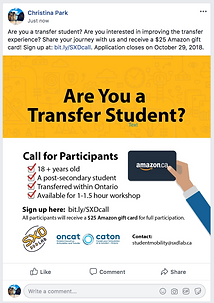
We used several channels to recruit students around Ontario such as Facebook, Twitter, Instagram, and printed English & French posters.


Journey Mapping
We led recent transfer students through journey mapping sessions where they shared their transfer experiences from beginning to end. They were asked to include their positive and negative experiences and the resources used. At the same time, we asked them to evaluate resource effectiveness and helpfulness. We concluded each workshop by asking what they hoped to see to improve this experience for future transfer students. With the understanding that technology has changed students’ expectations and needs, we also conducted our own evaluation of the current resources available and the limitations in accessing them.


Synthesis
We identified several barriers to a satisfying transfer process, including challenging website navigation, information overload, and unclear deadlines. In addition, we learned from students that they value technology, as well as face-to-face interactions.


Two major user personas are developed from our user research:
-
College to University transfer to pursue further study;
-
University to University transfer to change program or study (or simply attend a different institution that is closer to hometown).
Experience Map
Based on the synthesis on individual journey maps and interview data, we created a conclusive experience map.
It identifies the key phases of student transfer experience and concludes by providing opportunities for our client to improve the overall student experience.

Ideate
Brainstorming
100 Ideas
Following the synthesis, the team got together to generate 100 ideas! We focused on quantity over quality to create as many ideas as we could. The more ideas you generate at this stage, the more great options you will have to choose from later. Then, we looked for ways that ideas and concepts can be combined to make unique, new ideas.
Identifying new combinations is the key to great innovation.

Storyboarding


Test
Usability Testing
We conducted 3 rounds of user testing with students with and without transfer experience. We tested the following features:
-
Tasks and calendar overview
-
Calendar integration
-
-
Reminders and notifications
-
Contact a transfer advisor
-
Direction to information to assist with tasks
-
Information requested and user experience of creating profile
In addition, System Usability Scale (SUS) was used to quantitatively measure the usability of the app.


Student, College
I like how this app uses technology to make it easy to connect people to people rather than replacing that.

Student, University
Meeting the deadline was a big source of anxiety when I was applying to university. Downloading this app would solve that problem.

Student, University
The app is simple and easy to use.
It's not complicated and that is a big plus.
What our users are saying
Highlights
Student Led Design
at the SXD Lab.
The SXD Lab is an Ontario innovation hub that tackles some of the most complex problems facing post-secondary education today. The focus is exclusively on student-led innovation. Why? Because students have historically been excluded from meaningful participation in the design and operation of the higher education system that exists to serve them.
At the SXD Lab, eCampusOntario, we use human-centred design processes and tools to (re)design better student experiences. We do this by working with the end users of education: students. We conduct user research, define specific problems, generate and test ideas, and develop innovative solutions with institutions and industry.
Co-designed with:
Nikole McGregor
Roya Matsui
Angelina Pletneva
ONCAT
Takeaways
What have I learned from this experience?
1
How to confidently represent users and give voices to the end user when speaking to the client.
2
Creating a video is an excellent method of storyboarding and storytelling.
3
Composing scalability plan and systems diagram.
What would I have done differently?
1
Scheduling user research sessions immediately. Otherwise, we lost a few potentially interested participants.
2
Strategize and consider both in-person and online sessions for user research & testing.
3
Have more rounds of user testing and iterate more times with less users per round to gain new insights.