The Effectiveness of New Experiential Technologies at the Anthropocene
- Christina

- Nov 17, 2018
- 4 min read

The Anthropocene reveals immense scale and scope of humanity’s impact on the Earth through a series of photographs, large-scale murals augmented by film extensions, film installations, and augmented reality installations created by Edward Burtynsky, Jennifer Baichwal and Nicholas de Pencier. Through exploring the innovative use of technology influencing the ways visitors see, experience, and understand the exhibition, the relationship between participation and spectacle is examined. The new experiential technologies used in the exhibition alters the traditional museum experience in communicating the humanity’s impact on the Earth. Placing visitor activity at the core, technology in the blockbuster exhibition is critically analyzed for its effectiveness as communicator of ideas through creating immersive experience, opportunity for reflection, the visitor as the spectacle, and brand-building value.
This thematic map that I designed deconstructs the exhibition, identifies the exhibition's interpretive infrastructure, and take note of the arrangement of themes and storylines in space, and reflect on the exhibition’s big idea.

AR Interaction and Immersive Experience
The physical space and the spatial arrangement takes on the standardized methods of display resembling the White Cube. However, rather than the unshadowed, white, clean, artificial atmospheric limitation of the White Cube, visitors are encouraged to actively and physically move around engaging with the artworks. Visitors are introduced to an immersive space that indeed “take us to places we are deeply connected to – but normally never see,” as if being transported to an unfamiliar environment.
Our ambition is for the work to be revelatory, not accusatory, as we examine human influence on the Earth both on a planetary scale and in geological time. - Edward Burtynsky, Jennifer Baichwal and Nicholas de Pencier
The ability to hold a personal device in the hands and listen to the sounds playing from each film extensions create dramatic illustrations that stimulate our tactile, auditory and visual senses. The hands-on experience creates a dynamic dialogue between the visitors and the static artworks on display creating compelling museum experiences.
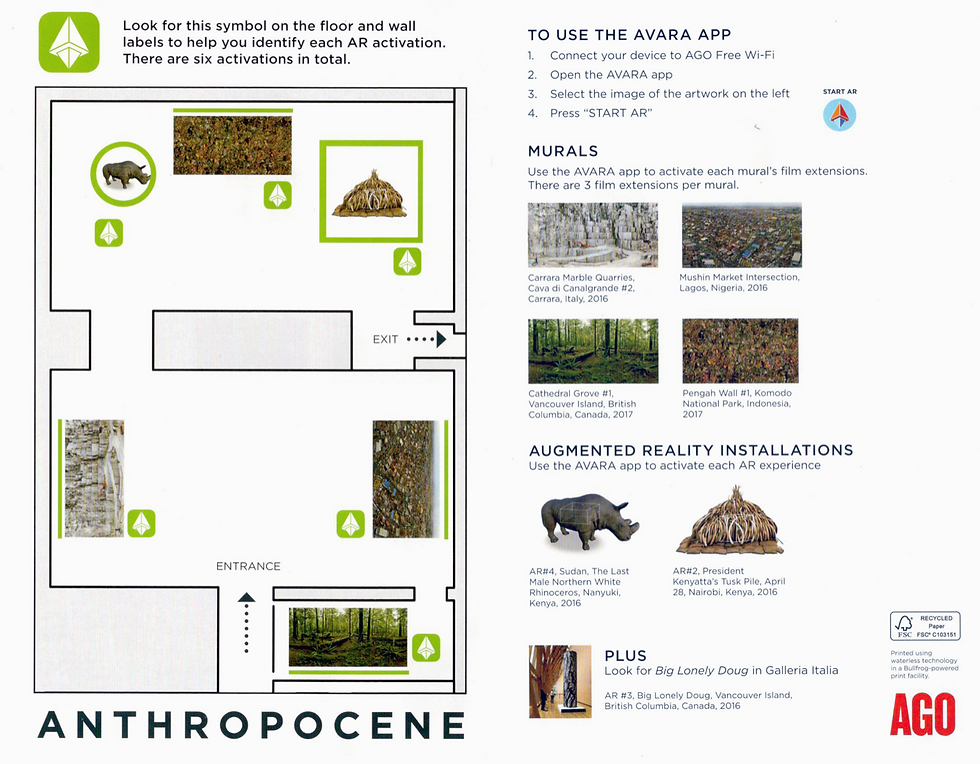
While the interactivity and new experiential technologies are crucial components of the exhibition, it fetishizes the new experiential technologies (Hughes, 2001). The exhibition map distributed at the entrance outlines only the location of the interactive components. It only highlights the works that involve the mobile application called AVARA. Additionally, there are more volunteers merely offering technical assistance than docents to converse with about the exhibition.
Inclusivity & Accessibility
If activating an exhibit failed to create immediate and, preferably, spectacular change, the visitor moved on to the next on. - Patrick Hughes
The AGO implements strategies to create a seamless user experience. The instructions from the proof of purchase email and Download Hub at the lobby encourage visitors to download the AVARA app prior to their visit. Varied level of technical literacy and access to technology is acknowledged. Free wifi and hands on service at the Download Hub is offered to the visitors. Four iPads are made available for every interactive piece. Moreover, TV monitors are installed near the AR sculptures to demonstrate the interaction to ensure no one misses out from this crucial experience.
At the same time, the exhibition poses some user experience challenges and accessibility concerns. The object labels and download instructions on the patterned floor poses some critical readability challenges to visually impaired visitors including seniors due to the lack of contrast. Incorporating the didactics in the mobile application to reflect the interpretive object labels from the exhibition would have resolved the issue.
Digital Approach for Reflection
In a word, how does what you’ve seen here today make you feel?
There is a visitor response area called Change Station. Located at the exit, it gives visitors the opportunity to reveal their thoughts about what they have experienced in the exhibition. A digital approach is taken for visitors to share their emotional response by choosing one of the seven emotions. Regrettably, the seven emotions do not encompass all types of human emotions.
The section banner encourages visitors to visit some webpages, for example, to learn about the AGO’s eco-friendly initiatives or how artists are making positive changes to the environment. It appears to be disengaging to ask visitors to manually enter the link to visit a website. Without visiting the recommended webpages, there appears to be a mismatch in what the artists’ attempt to communicate versus the artistic and curatorial practice in the extensive use of paper, decals, tablets actively producing technofossils. Perhaps the use of tablets could have been extended here to provide immediate access to all visitors.
Visitor Activity as Spectacle (Social Media)
The use of social media for photo sharing plays an important role in the exhibit experience. The hashtag #AnthropoceneProject is actively promoted through the program brochures, websites, introductory panels, and as wall texts. Furthermore, visitors’ social media posting are randomly shared on the TV monitors in the charging area and the AGO webpage.

This reflects the strategy characterizing the exhibitionary complex: the crowd as the ultimate spectacle. The AVARA app allows visitors to take photos, leveraging technology to create and share their own personal experiences with art. The active use of social media pushes the exhibition beyond its four walls, engaging in communications with visitors who are physically or virtually visiting the exhibition. The potential sharing resonates with the idea that what one sees is the result of individual and collective activities that we all helped to create. The artists travelled around the world to document the human marks and the social media in turn encourages visitors to share their experience globally leaving digital footprints. Concurrently, social media further aims for maximum coverage and maximum publicity to attract maximum attendance as visitors places themselves as a spectacle.
Technology and Brand-Building
The Anthropocene reinforces the AGO’s vision to be a pre-eminent art museum that inspire audiences and create community through art in innovative ways (“About”). It effectively contributes to the AGO’s brand-building strategies as the industry leader with innovative practices with active incorporation of technology. The Business Plans identifies growing use of digital technologies as a vehicle to connect with audiences and a tool for reaching larger, more diverse audiences (3). It is important to acknowledge that enjoyment and entertainment are motivations for museum visitors and “skillful use of contemporary technology and social media can significantly enhance museums’ entertainment quotient” (Lord & Piacente 11)
The Anthropocene, the AGO’s yet another blockbuster exhibit featuring celebrity artists, fulfils the goal of attracting “new and diverse audiences to grow attendance.


Comments